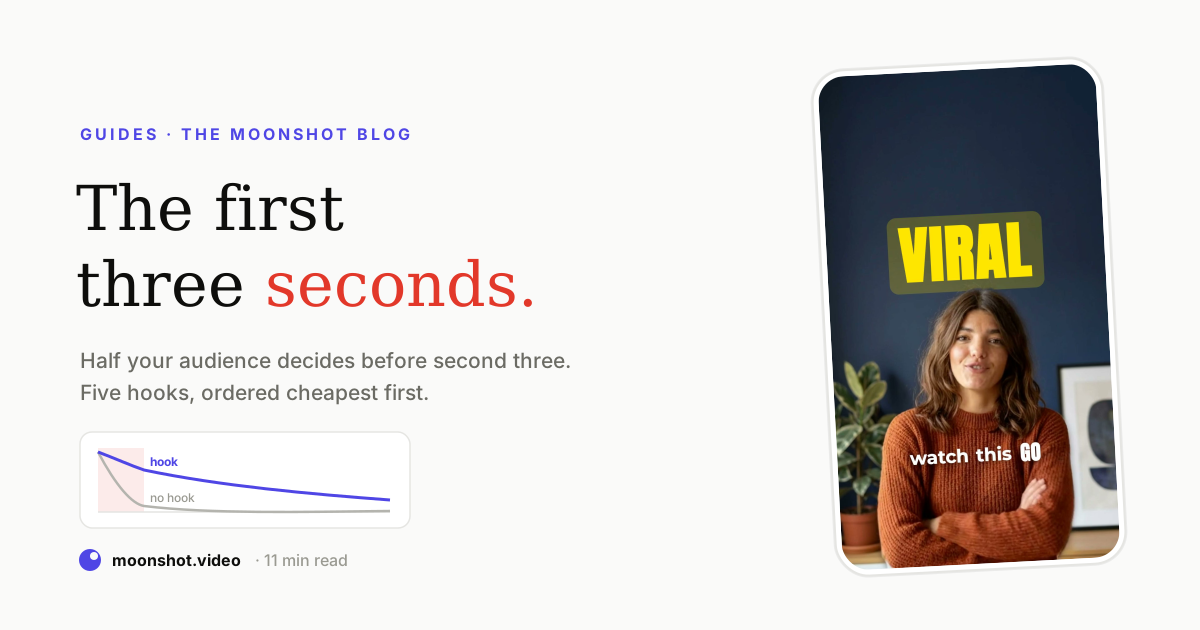
A short-form video is not published, it is auditioned. The platform shows it to a small batch of people, watches what they do in the opening moments, and decides from that alone whether to buy more distribution. Roughly half the people who ever see your clip make their stay-or-scroll decision before the third second — which means the first three seconds aren’t the introduction to your video. They are your video, as far as reach is concerned. Everything after is a conversation with the survivors.
What the feed is actually measuring
Instagram has been steadily moving its creator-facing metrics toward the number that matters: skip rate — the share of viewers who bail in roughly the first three seconds. TikTok and YouTube Shorts run the same logic under different names. The mechanism is worth understanding literally, because it explains behavior that otherwise looks random:
- Your clip goes to a small seed audience — people who already follow you, plus a thin slice of cold traffic.
- The system reads the opening seconds as a vote. Hold them, and it buys a bigger batch. Lose them, and distribution is quietly capped — no penalty, no notification, just a ceiling.
- Every subsequent batch re-runs the same test, with colder and colder viewers. A hook that works on your followers and fails on strangers is exactly what a clip that “did fine and then stopped” looks like from the inside.
This is why hook work has better leverage than almost any other edit. Improving the back half of a video improves the experience of people who already stayed. Improving the first three seconds changes the size of the audience that ever reaches the back half.
A hook has two jobs, and most only do one
The word “hook” gets used for one thing, but the opening actually has to do two very different jobs in parallel, and they fail differently.
Job one is orientation. A stranger has landed mid-stream with no context. Within about a second they are answering: what am I looking at, and is it for me? If they can’t answer, they leave — not because they disliked it, but because ambiguity is more expensive than scrolling. Orientation failures look like good videos with bad numbers.
Job two is tension. Knowing what something is gives no reason to stay. Something has to be unresolved — a promise, a number not yet explained, a claim that contradicts what they believe, a visual that doesn’t make sense yet. Tension failures look like clear, professional, entirely skippable clips.
The ladder: five hooks, cheapest first
There isn’t one hook — there are layers, and they stack. What follows is ordered by effort, not importance. Rung one takes two minutes and is the one most people skip.
Rung 1 — The text hook
A short line of text burned into the frame from the very first frame. It is the cheapest intervention available, it requires no reshoot, and it is the only one that works when the phone is on silent — which is how a large share of feed viewing starts.
Be precise about what a text hook is for. It is not a title, and it is not a summary. Its job is job one from above — orientation — plus as much of job two as you can fit in seven words. It tells a stranger, instantly and without audio, what they’ve landed on and why leaving would cost them something.
alone, read
this first
killing your
reach
The rules that consistently separate the two columns above:
- Name the audience or the stakes. “My morning routine” is a topic. “If you edit alone, read this first” is an address. Addressed viewers self-select and stay; browsers keep browsing.
- Be specific. Numbers, named things, and concrete consequences outperform adjectives. “3 settings killing your reach” carries a countable promise; “important tips” carries none.
- Withhold exactly one thing. The gap is the engine. State the claim, keep the resolution. Not a mystery — a specific, closable loop.
- Frame one, full size. A hook that fades in over 800 ms is a hook that arrives after the decision. No fade, no animation-in, no small type that grows.
- Three to seven words, two or three lines. Past that, it becomes reading, and reading competes with watching instead of supporting it. The same limit that governs caption line length applies here, harder.
- Out of the crop zone. Keep it clear of the top and bottom bands where the UI, the username, and the caption tray sit — and clear of the area a profile-grid crop will slice off.
Rung 2 — The spoken hook
Almost every clip is recorded with a runway: a greeting, a throat-clear, a bit of setup that made sense while filming and is dead weight in a feed. The single highest-yield cut in short-form editing is deleting everything before your first real sentence.
The fix is a cold open: start on the thesis, the strongest claim, or the result — then backfill the context afterward, once the viewer has a reason to want it. Practically:
- Cut the greeting. “Hey guys” addresses an audience that hasn’t agreed to be one yet.
- Open on the sentence you’d put in a headline. If the best line in your clip is at 0:34, that line is your first line. Say it, then earn it.
- State the conclusion before the reasoning. Feed content is not an essay; the payoff goes first and the argument becomes the retention device.
- Match your words to your text. When the spoken line and the on-screen line say the same thing in the same words, they reinforce instead of competing — and the automatic transcription platforms run over your audio sees the same keywords twice.
Rung 3 — The visual hook
Text and speech both require processing. The visual channel doesn’t: motion, faces, and things that break a pattern grab attention reflexively, before anything is read. That makes the visual hook slower to produce and faster to land.
What actually works in the first frames, roughly in order of reliability:
- Open on the payoff frame. If your clip contains one striking image — the finished thing, the mess, the reaction — it belongs in second zero, not second forty. Show it, then rewind. This is the visual version of the cold open.
- Movement inside frame one. A static talking head starting from rest looks like a paused video. Enter mid-gesture, mid-walk, mid-pour. The subject should already be doing something when the clip starts.
- A pattern interrupt. Something that doesn’t belong — an unexpected object, a jarring cut, a scale mismatch. Novelty is the one thing the visual system is guaranteed to route attention to.
- A face, looking at the lens. Direct gaze is close to unignorable, and it converts a broadcast into an address.
- Depth. Text that passes behind the subject reads as part of the room rather than an overlay stuck on the glass, and overlay text is the exact thing feed viewers have trained themselves to ignore. We took that mechanism apart in The Kumar template, explained.
Rung 4 — The audio hook
For the meaningful share of viewers who scroll with sound on, audio arrives before anything is read — it is the fastest channel you have. The mistakes are unforced:
- Silence at the start. A half-second of room tone before you speak reads as a video that hasn’t started. Trim to the first syllable.
- Music that fades in. A fade is a four-second commitment from a viewer who has given you three. Start music at level, on the first frame.
- Nothing to lock onto. A recognizable trending sound in the opening buys familiarity, and familiarity buys a beat of patience. Sound design does the same job — a single sharp transient on the first frame is enough to say this has been made.
- Loudness that ramps. Your opening should be as loud as your loudest moment. Viewers adjust volume once, at the start, and won’t do it twice.
Rung 5 — The re-hook, and the second cliff
Holding three seconds gets you a bigger audition, not a finished job. There’s a second, smaller cliff around eight to ten seconds — the moment a viewer works out whether the promise is actually going to be paid. Clips that hold the first and lose the second are the most common failure among people who’ve already learned to write hooks.
- Pay something early. Deliver one concrete piece of the promise before the ten-second mark, so the loop is proven closable.
- Open the next loop while closing this one. “That’s the first one — the third is the one that actually cost me money.”
- Change something visually every few seconds. A cut, a scale change, a new caption treatment. Uninterrupted sameness reads as a video that has ended.
- Don’t bury the payoff behind a plea. “But first, make sure you follow” is a request for payment before delivery, at exactly the moment the viewer is deciding whether you deliver at all.
Five ways good clips lose the opening
| The mistake | Why it costs you | The fix |
|---|---|---|
| Hook animates in | Arrives after the decision window has closed | Full size, frame one, no fade |
| Hook describes the topic | Orientation without tension — nothing to resolve | Add a number, a stake, or a contradiction |
| Hook is only in the caption | Read after the scroll decision, if at all | Burn it into the frame |
| Four seconds of greeting | Spends the entire window on runway | Cut to your first real sentence |
| Text sits under the UI | Half the hook is behind the username and buttons | Keep it inside the safe centre band |
How this works in Moonshot
Hooks are the reason Moonshot reads your transcript before it renders anything. When a clip is processed, a language model reads what you actually said and proposes short opening lines drawn from your own words — then the strongest one is set as the clip’s hook and rendered as a title card over the opening seconds, at full size from the first frame, in the same typeface family as your caption template. You can accept it, edit it, or type your own; the line is capped to a handful of words and trimmed at a clause boundary so it never ends on a dangling “the.”
Rungs two through four are still yours — but the two-minute rung is done before you open the editor. And because the same hook line feeds the cover image, the promise a viewer reads before pressing play is the same one they see at frame one.
Quick answers
How long should a hook be?
Three to four seconds of screen time, and three to seven words if it's a text hook. That's not a style rule — it's the window before the viewer's scroll decision resolves. A hook that needs eight seconds to land is not a hook, it's an intro.
What is skip rate on Instagram?
The share of viewers who leave a Reel within roughly its first three seconds. It's the inverse of the old view-rate framing and it's the number that most directly gates distribution: clips that hold people past the opening get shown to more non-followers, clips that don't get quietly capped.
Is a text hook enough on its own?
It's the highest return per minute of effort, and for most creators it's the missing 80%. But a text hook only answers 'what is this?' — it doesn't create tension or reward the eye. The stack in this article layers a spoken hook, a visual hook, and an audio hook on top, in that order of difficulty.
Should the hook be in the caption or on the video?
On the video. The written caption below a Reel is collapsed to one line and read after the decision has already been made. The hook has to be burned into the frame, legible with the sound off, at full size, from frame one.
Why do my Reels get views but no watch time?
Usually the opposite problem: the hook works and the second beat doesn't. Attention has two cliffs — one at three seconds and another around eight to ten, when the viewer realizes the payoff isn't coming. If you hold the first and lose the second, you need a re-hook, not a better opening line.
Get a hook written from your own words
Upload a clip and Moonshot transcribes it, drafts hook lines from what you actually said, and renders the one you pick as a full-size title card over your opening seconds.
Open Moonshot free