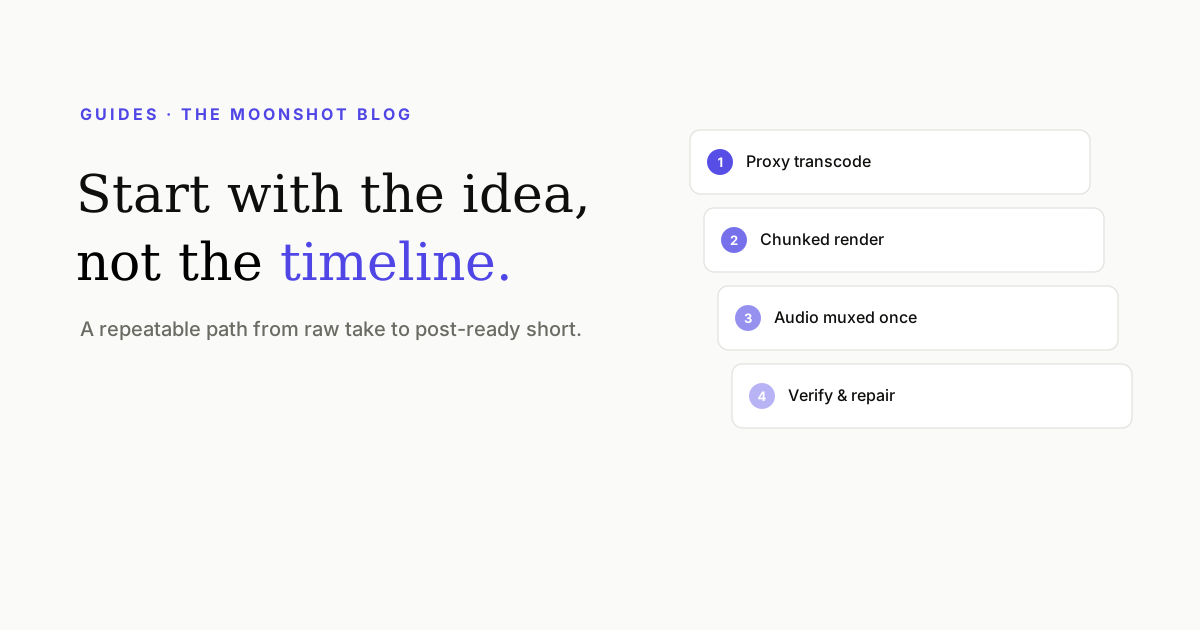
The timeline is a representation of media, not a plan for thinking. A repeatable short-form workflow starts with the claim, moves through the transcript and structure, then adds captions and packaging only after the content is stable. Each stage closes one class of decision before the next opens.
The six stages
| Stage | Output | Do not do yet |
|---|---|---|
| 1. Claim | One specific promise | Pick effects |
| 2. Transcript | Accurate editable words | Style captions |
| 3. Structure | Hook, proof, payoff | Design the cover |
| 4. Captions | Readable timed text | Add decorative B-roll |
| 5. Packaging | Cover, title, description | Reopen the core edit |
| 6. Check | Approved final file | Keep polishing |
1. Reduce the idea to a claim
Topics are too large to edit. “Pricing strategy” offers no stopping rule; “your free plan is making the paid plan look risky” tells you exactly what the clip must prove. Write the claim before choosing a take.
A useful claim has tension and a boundary. It can be understood without your bio, and one example can support it. If it needs five caveats, it is probably a series rather than a short.
2. Turn the recording into editable language
Transcribe the selected take before making detailed cuts. Words expose repetition and weak order faster than a waveform does. Correct names and numbers now; every later layer depends on them.
3. Lock hook, proof and payoff
Start on the strongest version of the claim. Follow with the minimum context required to believe it, then one piece of proof. End when the opening promise is paid—before the conversational outro begins.
- Hook: the sentence that opens a useful question.
- Proof: the example, contrast or demonstration that changes belief.
- Payoff: the answer, action or consequence promised at the start.
The first pass in our talking-head editing checklist uses this structure, while the first-three-seconds guide shows how to strengthen the opening without turning it into clickbait.
4. Add captions as information design
Once the speech is stable, choose a caption treatment that matches the register of the clip. Correct the transcript, break lines by thought, place the block inside the shared vertical safe centre, then add sparse emphasis.
Do the quality passes in how to fix auto captions before adding special hero words or behind-subject layers. Accuracy is the base layer of the design.
5. Package the promise you actually delivered
Choose the cover after the edit because the finished clip tells you which claim survived and which expression or frame supports it. Write a short cover line that names the tension, result or object—not a transcript of the first sentence.
The cover, title and first spoken line should point at the same payoff from different angles. If the cover promises a five-step system and the video delivers one opinion, the package may win the click and lose trust.
6. Run a bounded quality check
- Watch once with sound on for pacing and edit seams.
- Watch once with sound off for captions and visual comprehension.
- Check the opening frame, brightest frame and longest caption.
- Confirm the cover survives its crop and the final file has the intended dimensions.
Give the check a boundary. Without one, polishing expands to fill every minute available and the publishing cadence disappears.
How to batch without making every clip identical
Batch the repeated decisions, not the ideas. Record several claims in one session, reuse a caption system and export preset, then let the hook, proof and cover remain specific to each clip. Consistency should remove setup work—not erase the reason a clip exists.
Quick answers
What is a good workflow for short-form video?
Move through six locked stages: claim, transcript, structure, captions, packaging, final quality check. Finish the spoken structure before styling, and finish the video before designing the cover.
Should I write a full script for a Reel?
Write the claim, opening and proof beats. A full script helps precise educational content; a short outline often sounds more natural for creator-led clips. In both cases, edit the resulting transcript rather than forcing the recording to match the draft.
When should I add captions?
After the structural cut is stable. Captioning earlier means every deleted sentence, timing change and reordered phrase creates visual work that must be repeated.
When should I make the thumbnail or Reel cover?
After the final claim and strongest frame are known, but before publishing. The cover should promise the same payoff the video delivers, not a broader idea invented after the edit.
Keep the whole short in one workflow
Moonshot turns the transcript into the editor, then keeps captions, hook options and thumbnail frames attached to the same clip.
Build a short free